Thursday, December 29, 2011

Brennan Manning's "All Is Grace: A Ragamuffin Memoir"


If you were to read Brennan Manning's "All Is Grace" without having read some of his other books, I wonder if you would be has moved as I was. I believe the answer is, "Yes." However, if you're reading this and have not yet read one of his books, it would be my desire to have you start first with "Abba's Child: The Cry of the Heart for Intimate Belonging." Then in true Wizard of Oz fashion, you could move on to this memoir and see the man behind the curtain.

Subtitled "A Ragamuffin Memoir," Manning's "All Is Grace" was just recently released on October 4, 2011. It is impossible to express with words just what Manning means to me. For those that know me, I can try by using an analogy to music. His teachings have affected me like Bruce Springsteen's music has, only more. I can try by using a film smile: Brennan Manning is like Cameron Crowe to me.

I was never under any delusion that Manning was the Great Oz, so, upon reading this very candid memoir, I was in no way disappointed to find "just a man" standing in a booth. In fact, why would one be shocked? After all, Manning is most famous for being a self-proclaimed "ragamuffin" and, his most famous book, "The Ragamuffin Gospel" is a de facto confession that this spreader of good news is indeed "bedraggled, beat-up, and burnt out." I shouldn't have been surprised. After all, one of his funny tag lines when speaking is: "Aristotle said, 'I am a rational animal;' I say, "I am an angel with an incredible capacity for beer." Yet, this book is so candid, that truthful, I found myself crying, not teary-eyed, but crying. Why? It wasn't because my "hero" Manning had sunk so low. No, rather it was because in reading this book, I received a clear reminder that's God's love and grace are scandalous enough as to even cover a "non-hero" with this many chinks in his armor!

I don't want to reveal any of the real "meat" of his memoir in this post. Thus, in order to give you an idea of how "real" Manning gets, I will share one of my favorite sections. In said section, the author addresses the burning question often presented to him: "Brennan, how could you relapse into alcoholism after your Abba encounters?" I will not tell you his answer, but I will share a quote that Manning himself felt was important enough to print in full. I had never read the author he quoted before, as such, I found this quotation deeply effective. These words are pulled from Fil Anderson's book, "Breaking the Rules":

My highest hope is for all of us to stop trying to fool others by appearing to have our act together. As people living in intimate union with God, we need to become better known for what and who we actually are. Perhaps a good place to begin would be telling the world--before the world does its own investigation-that we're not as bad as they think. We're worse. At least I know that I'm worse.

Let's get real. For every mean-spirited, judgmental thing some preacher has said, I've thought something nastier, more hateful and more cutting about one of my neighbors. For every alleged act of homophobia by my fellow Christians, I've done something stupid to demonstrate my manliness. For every brother or sister whose moral failure has been exposed, I've failed privately. No matter how boring followers of Jesus may appear to be to the outsiders, they don't know the half of it; trust me.... If we really believe the gospel we proclaim, we'll be honest about or own beauty and brokenness, and the beautiful broken One will make himself know to our neighbors through the chinks in our armor--and in theirs. (pages 178-179 of "All Is Grace")

That is the end of the Anderson quote. The reason I was so deeply moved by it is that it raises the bar for me. It reminds me that I don't need to be anybody other than who I am. It should be noted that that Manning lives up to this quote, admitting, among other things that he has Wernicke-Korsakoff syndrome, or what us alcoholics commonly refer to as "wet brain." So, in true Manning fashion, I don't want to use this post here to make myself look better; thus, I must also admit that this entire section of the book reminded me of my own horrible shortcomings. And, that is a good thing because it, once again, throws me at the feet and mercy of my Abba! Take just one sentence: "For every brother or sister whose moral failure has been exposed, I've failed privately." Wow! How true is that!?! Just one thing this book did for me is it reminded me that I have no right to be "holier than thou" or judgmental because it's a very level playing field, and, as the title says, "All Is Grace." Fine, I will admit it here and now: I am so full of myself that if I had to write a memoir I'd probably title it "All Is Doah." Well, actually, I'm so bad that I would probably only think that, but I wouldn't have the guts to actually do it because I would be too busy worrying about what you might think if you actually knew how self-centered I truly am.

Yes, I am a recovering narcissist. Indeed, I bet there are not even truly altruistic reasons for me even confessing that truth! That said, this topic brings me to another favorite section of Manning's memoir. This part of the book appears much earlier than the aforementioned Fil Anderson quote. In this section, Manning tells of his stint in the Little Brothers of Jesus which is a fraternity founded by a priest named Charles de Foucauld. In 1967 while he was in his "candidacy" to become Little Brother, Manning spent six months in a small village in France. After becoming a Little Brother he moved onto a small village in the desert of Spain. During this time of his life Manning did such non-glamerous things as shoveling manure, washing dishes, befriending the poor, carrying water, and building chicken coops. What's amazing is the realization Manning comes to. He writes:

Even though I had done well in my desert classroom, my motives were peeled away to reveal complete self-centered yuck. Can you be a self-centered chicken-coop builder? Can a water carrier be stuck on himself? The answer I heard was a resounding and humbling "Yes!" That old desire to be liked reared its ugly head. I thought maybe I had grown beyond it or out of it, but I hadn't. I was devastated; everything felt Brennan-centered instead of Christ-focused. (page102)

While I, Doah, would love to put that last sentence on you, I won't. Oh, how I would like to write something like, "Who among us hasn't felt like that?" But, that would be my own insecurities not really owning how Doah-centered I am. You see, the reason I love this book is that it makes me look into the mirror-waters of the pool and see not my face, but the face of Jesus. In reading this book, I see the reflection of Jesus look back at me and he lovingly says, "Doah, it's not about you." You see, in the same way that one could be a self-centered chicken-coop builder, I often walk around my house kidding myself that I am a loving servant, but, in reality I am a self-centered toilet cleaner, a cook who is full of himself, a husband and a father who far too often doesn't love the way Jesus has loved me. This memoir by Brennan Manning makes me want to not "try harder" which would be a shame. Rather, it reminds me of the lavish grace I have received; thus, making me want to give more grace and love better!

Back to Manning's time in the Little Brothers. This part of his story leads me to a portion of the book that really made me think. He writes:

One of my realizations in such an earthy atmosphere was that many of the burning theological issues in the church were neither burning nor theological. It was not more rhetoric that Jesus demanded but personal renewal, fidelity to the gospel, and creative conduct. (p. 101)

You might want to read that above quote one more time. I love it! The burning theological issues in the church were neither burning nor theological. What this means to me is that we, as Christians, need not get bogged down in debates about side issues such as pretribulation, midtribulation, or posttribulation. (Ironically, some, no doubt will be bothered that I didn't write those three terms with hyphens and capital letters.) Instead, we should focus on what Manning here calls "creative conduct" and what I call simply loving well.

I could go on and on about this latest book by my all-time favorite author. I could fill this blog with so many quotations that you wouldn't even need to read the book. I could get into the real sad stuff that made me cry. For example, I could reveal the one act that led the author to fell the most profound shame of his life and ask the questions: "My God, what kind of a man am I? How could that have happened?" But, I won't reveal it. What I will tell you is that Manning answers the question, "What is the telltale sign of a trusting heart?" The answer is: "A trusting heart is forgiven and, in turn, forgives." And, even though this book was written by "the liar, tramp, and thief" who was "otherwise known as the priest, speaker, and author," it was equally written by a man with a trusting heart, a trusting heart that has truly, deeply, and profoundly affected the ragamuffin who wrote this blog post.

In closing, I must touch upon the final part of the book, a short section by John Blase called "A Word After." I must close with this because there is nothing I could write that could possibly summarize what Brennan Manning means to me better than this small quotation by Blase. He writes that Manning's:

consistent banging on the drums of God's unconditional love sounded at a time when many of us had about "had it up to here" with religion and church and, probably most importantly, ourselves. We were the tired, poor, self-hating huddled masses yearning to be free, and along came a patchwork preacher who grinned and said, "You already are. Abba loves you. Let's go get some chocolate ice cream." (p. 200-201)

Yes, I can admit that Blase describes me there. I used to be self-hating and I certainly have, numerous times, had it up to here with myself! Mr. Brennan Manning's teachings helped me reframe my identity. As I closed the back cover against the final page of "All Is Grace," I closed it really, truly, absolutely believing that Abba loves me. I will return the book to my friend, Lorie Taylor, a fellow ragamuffin, with the absolute faith, a vision really of some "time" in the "future" my wife and I, along with Lorie and her husband, will be sitting around a table on the other side of eternity sharing a chocolate ice cream cone with one Richard Manning. We'll be laughing about how wonderfully messed up and beautiful we all really are!

Labels: , ,

Thursday, July 09, 2009

Moral Exterminators vs. The Sweet Smell Of Grace


The lack of inactivity in terms of actual meaningful posts might lead you to believe that I am in some sort of thoughtless wilderness. Not true. God has been telling me tons of stuff lately. I dare say I am in a period that might end up yielding a "spike" in the spiritual line graph of my life.

I'm currently reading a great book, WHAT'S SO AMAZING ABOUT GRACE?, by Philip Yancey.  This book could produce endless posts, but I thought I would just share one passage. The following passage comes from chapter twelve. Titled "No Oddballs Allowed," this chapter deals with an issue that is of increasing importance to me: Jesus' love of the so called "defectives" among us, me included.

Yancey writes as follows:

A phrase used by both Peter and Paul has become one of my favorite images from the New Testament. We are to administer, or "dispense," God's grace, say the two apostles. The image brings to mind one of the old-fashioned "atomizers" women used before the perfection of spray technology. Squeeze a rubber bulb, and droplets of perfume come shooting out of the fine holes at the other end. A few drops suffice for a whole body; a few pumps change the atmosphere in a room. That is how grace should work, I think. It does not convert the entire world or an entire society, but it does enrich the atmosphere.
Now I worry that the prevailing image of Christians has changed from that of a perfume atomizer to a different spray apparatus: the kind used by insect exterminators. There's a roach! Pump, spray, pump, spray. There's a spot of evil. Pump, spray, pump, spray. Some Christians I know have taken on the task of "moral exterminator" for the evil-infested society around them.
I share a deep concern for our society. I am struck, though, by the alternative power of mercy as demonstrated by Jesus, who came for the sick and not the well, for the sinners and not the righteous. Jesus never countenanced evil, but he did stand ready to forgive it. Somehow, he gained the reputation as a lover of sinners, a reputation that his followers are in danger of losing today. As Dorothy Day put it, "I really only love God as much as I love the person I love the least."
There's so much there in that quote. The first thing is that I absolutely love the quote from Dorothy Day. It is so right on! The second thing is that the above passage makes me ask myself: "Am I pumping a sweet grace into the air or am I pumping poison onto those around me?" I don't want to pump the poison.
I also dig the line that says Jesus gained the reputation as a lover of sinners, a reputation that his followers are in danger of losing today. This is so true and so sad! This reminds me of a line delivered by Flanders' wife in The Simpsons wherein she says, "I've been going to Bible classes. They're teaching me to be more judgmental." Sadly, this perception of us Christians is becoming increasingly accurate; however, this is not how Jesus himself operated. In a very user-friendly move, the author of this book sums up the Old Testament laws as follows: "No Oddballs Allowed." He then points out that Jesus brought another message.
Earlier in the chapter Yancey states:  Jesus' approach to "unclean" people dismayed his countrymen and, in the end, helped to get him crucified. In essence, Jesus canceled the cherished principle of the Old Testament, No Oddballs Allowed, replacing it with a new rule of grace: "We're all oddballs, but God loves us anyhow."
To drive this point home Yancey uses the Bible scene found in Acts 10 where in Peter finds himself smack dab in the center of the eye of the hurricane in God's beautiful storm of grace. Read all of Acts 10, but consider this line from Acts 10:28 wherein Peter says, "You know it is against the Jewish laws for me to come into a Gentile home like this.  But God has shown me that I should never think of anyone as impure." Peter found that Jesus' church even had room for "unclean" Gentiles like me!
Like the Pharisees of Jesus' day, many among the so-called Christian fundamentalist right are scandalized by a message such as the one Jesus preached. My question for them today is: Are you spreading the sweet aroma of grace or pumping poison onto those non-Christians around you?

Labels: , ,

Sunday, June 15, 2008

Good News on Father's Day!

So it's Father's Day.  Wes woke me up telling me that he made me breakfast.  He did. It was thoughtful and yummy.  Zoey and Kasey honored me with the love of a six and four year old as they brought me their school crafts that might as well have been Springsteen tickets. Chrisy got me pounds and pounds of my favorite Peet's Coffee. Max wrote these words to me:  "Dad, I love you soooo much.  I am so thankful for the things you do for me like make me eggs and clean the house.  And most of all I love it when you watch movies with me and teach me about music."  I think that last line meant so much to me because to me it meant, "I like YOU just the way you are, I like your interests, and I like to spend time with you."  Good stuff, huh?  But, it's hardly the best news of the day.
This morning in my junior high group at church I focused on the idea of "the Good News" and I essentially asked the kids if they truly believed that God loved them fully right now.  I drew heavily on one of the greatest books I've ever read.  It is called THE RAGAMUFFIN GOSPEL.  It's by Brennan Manning.  I really started thinking about this book again this morning. Something deep within my heart welled up saying, "Doah, my grace is the best gift you will ever receive. Doah, my grace is the best gift you could give to your children. What's more, you've got to tell this Good News to the junior highers!"

The best gift I ever received is recorded in Romans 1:17 and it says this:  
The Good News tells us how God makes us right in his sight.  This is accomplished from start to finish by faith.  As the Scriptures says, "It is through faith that a righteous person has life."
Here's a passage about this from Manning's book.  This comes from "Something Is Radically Wrong" which is the first chapter:
I believe the Reformation actually began the day Martin Luther was praying over the meaning of Paul's assertion that the gospel reveals the righteousness of God to us--it shows how faith leads to faith.  In other words, the righteous shall find life through faith (see Romans 1:17).  Like many Christians today, Luther wrestled through the night with this core question: How could the gospel of Christ be truly called "good news" if God is a righteous judge who rewards the good and punishes the evil? Did Jesus really have to come to reveal that terrifying message? How could the revelation of God in Christ Jesus be accurately called "news" since the Old Testament carried the same theme, or for that matter "good" with the threat of punishment hanging like a dark cloud over the valley of history?
"Justification by grace through faith" is the theologian's learned phrase for what Chesterton once called "the furious love of God."  He is not moody or capricious; He knows no seasons of change.  He has a single relentless stance toward us:  He loves us.  He is the only God man has ever heard of who loves sinners.  False gods--the gods of human manufacturing--despise sinners, but the Father of Jesus loves all, no matter what they do.  But of course, this is almost too incredible for us to accept. Nevertheless, the central affirmation of the Reformation stands:  Through no merit of ours, but by His mercy, we have been restored to a right relationship with God through life, death, and resurrection of His beloved Son.  This is the Good News, the gospel of grace.
My favorite passage may be this:
Here is the revelation bright as the evening star: Jesus comes for sinners, for those as outcast as tax collectors and for those caught up in the squalid choices and failed dreams.  He comes for corporate executives, street people, superstars, farmers, hookers, addicts, IRS agents, AIDS victims, and even used-car salesmen.  Jesus not only talks with these people but dines with them--fully aware that His table fellowship with sinners will raise the eyebrows of religious bureaucrats who hold up the robes and insignia of their authority to justify their condemnation of the truth and their rejection of the gospel of grace.
In that section Manning is talking about Matthew 9:9-13. You really have to read Matthew 9:9-13 here:
Matthew 9:9-13 (THE MESSAGE)
Passing along, Jesus saw a  man at his work collecting taxes.  His name was Matthew.  Jesus said, "Come along with me."  Matthew stood up and followed him. Later when Jesus was eating supper at Matthew's house with his close followers, a lot of disreputable characters came and joined them.  When the Pharisees saw him keeping this kind of company, they had a fit, and lit into Jesus' followers.  "What kind of example is this from your Teacher, acting cozy with crooks and riff-raff?"  Jesus overhearing shot back, "Who needs a doctor:  the healthy or the sick?  Go figure out what this Scripture means:  'I'm after mercy, not religion.' I'm here to invite outsiders, not coddle insiders."
Here is what Brennan Manning then says about that chunk of the Bible:
This passage should be read, reread, and memorized. Every Christian generation tries to dim the blinding brightness of its meaning because the gospel seems too good to be true.  We think salvation belongs to the proper and pious, to those who stand at a safe distance from the back alleys of existence, clucking their judgments at those who have been soiled by life. In the name of Grace, what has been the verdict of the Christian community on the stained life of Rock Hudson?  To the disclosure that he called a priest to his deathbed, confessed his sins, and cried out God for forgiveness?
I think we all need to reread this line:  Every Christian generation tries to dim the blinding brightness of its meaning because the gospel seems too good to be true.
I want to draw on Luke 23:39-43.  In this section of the Bible Jesus is on the cross and there are two criminals hanging beside him.  One of the criminals mocks Jesus, but the other criminal protested and then he said, "Jesus, remember me when you come into your Kingdom."  Jesus replied, "I assure you, today you will be with me in paradise."
So what did that criminal do to get salvation?  It goes back to Romans 1:17.  He just had faith.  He believed. This is what I so badly wanted the junior highers to get today: We don't have to do something or not do something to clean ourselves up and make ourselves presentable to God.  We are presentable now!  He loves us now!
It also goes back to the passage I shared in Matthew 9. Jesus has a place at the table for crooks and riff-raff. And, since I was among the riff-raff, that is indeed Good News! Again, Manning puts it this way:
Through no merit of ours, but by His mercy, we have been restored to a right relationship with God through the life, death, and resurrection of His beloved Son. This is the Good News, the gospel of grace.
Do you get that?  I can't do anything to earn God's approval!
So, this is where I am at today.  I do not want to pollute the message found in the gospel of grace.  I do not want to dilute the Good News.

Labels: , , , ,

Wednesday, May 21, 2008

Desire

"She's the candle burning in my room
I'm like the needle - needle and spoon
Over the counter with a shotgun
Pretty soon, everybody got one
And the fever when I'm beside her
Desire, desire . . . ."

--U2's "Desire"

"Coffee is strong at the Cafe Du Monde
Donuts are too hot to touch
Just like a fool, when those sweet goodies cool
I eat til I eat way too much
'cause Im livin on things that excite me
Be they pastry or lobster or love . . . ."

--Jimmy Buffett's "The Wino & I Know"

Awhile back my men's group went through the above-pictured book, "The Journey of Desire: Searching for the Life We Only Dreamed of" by John Eldredge. I didn't really like the book so I'm not saying you should read it. I did finish it, but I didn't love it. If you want a good book recommendation, please read my post from last week, Buy This Book.

Even though I'm not recommending Eldredge's book, it did get me thinking about desire, and I would like you to read this post.

What is desire? My dictionary says it's "a feeling that one would get pleasure or satisfaction by obtaining or possessing something."

If you read those song lyrics at the beginning of this post then you'll see that I am not alone in my belief that the objects of our desire aren't always things that are good for us. In the first song Bono alludes to the desire of a drug addict, melting drugs in a spoon over a candle in room somewhere, getting ready to deliver his desire into his arm via the needle. He also points out that some people desire something so much that they just grab a shotgun and go steal it. Then there's the Buffett lyrics. He's singing about things that anybody could fall victim to, like eating too many doughnuts. Eldredge never mentions these songs, it's just that I kept thinking about them during the entire first half of the book.

That's the biggest problem I had with "The Journey of Desire" book: Eldredge doesn't really tell his main point until very far into the book. In the first part of the book he pretty much says that desire is necessary for a meaningful life and then he points out that most Christians have decided not to reach for their desires because it opens us up to the pain of not obtaining them. There is lot I agree with. For example in chapter three he points out how our churches have actually (hopefully inadvertently) killed our desires and replaced desire with their more important goals of knowledge and performance. He writes:

"Jesus appeals to our desire because he came to speak to it. When we abandon desire, we no longer hear or understand what he is saying. But we have returned to the message of the synagogue; we are preaching the law. And desire is the enemy. After all, desire is the single major hindrance to the goal--getting us in line. We are told to kill desire and call it sanctification."

Oh, yes, sadly, I agree with this. Christianity is not about getting us in line, getting us to follow rules. It is not about knowledge or performance. Rather, it is about living life to its fullest. Yes, this important point is where I agree with Eldredge: We should never abandon desire to duty. One of his great lines is "Being offered tips and techniques for living a more dutiful life isn't even in the field of good news. We know in our hearts our dilemma cannot be: '"I sure wish I could be a more decent chap. What I really need is a program to improve my morals.' Now, Jesus seemed to think that what he was offering really and truly spoke to our dilemma."

However, I was so frustrated during the much of the book because, although Eldredge asserts that our dilemma is desire, he never defines desire. For too long he doesn't answer the troubling questions I had in my mind while reading: What kind of desire? What is the difference between godly desire and worldly desire? What if it's some married dude's desire to have an affair? What if I truly just desire to eat an entire pecan pie or whole carrot cake, surely that can't be good for me? So I kept singing the songs, "Just like a fool, when those sweet goodies cool, I eat till I eat way too much . . . . burnin' burnin' de-si-i-i-i-ire!"

So for almost the entire book I would find myself both agreeing and disagreeing with Eldredge. He writes some other things that I totally agree with such as: "This is the great lost truth of the Christian faith, that correction of Judaism made by Jesus and passed on to us: the goal of morality is not morality--it is ecstasy. You are intended for pleasure!" Then I would find myself saying, "This is far too easy."

In the end Eldredge does get to his point. He begins to get there in chapter 6. Then, thankfully comes chapter 7, "The Great Restoration" a chapter I would highly recommend. Here Eldredge links hope and desire. He states that you can only hope for what you truly desire and he begins to make it clear that when he was writing of "desire" for the previous 100 pages, he was using the term as a synonym for "godly desire." That he still doesn't appear to understand that many humans have evil desires that will derail their lives may be the fatal flaw of this book. Nevertheless, he is on to something when he starts telling the reader to desire God's promises.

In linking hope to desire Eldredge quotes 1 Peter 1:13: "Set your hope fully on the grace to be given you when Jesus Christ is revealed." And in the end of chapter 6 he finally spells it out: "Desire cannot live without hope. Yet we can only hope for what we desire." So our desires are that what we truly hope for. Then, in chapter 7, he gives this great illustration:

"We have made a nothing of eternity. If I told you that your income would triple next year, and that European vacation you've wanted is jut around the corner, you'd be excited, hopeful. The future would look promising. It seems possible, desirable. But our ideas of heaven, while possible, aren't all that desirable. Whatever it is we think is coming in the next season of our existence, we don't don't think it is worth getting all that excited about. We make nothing of eternity by enlarging the significance of this life and by diminishing the reality of what the next life is all about. Nearly every Christian I have spoken with has some idea that eternity is an unending church service."

How sad that I would desire a European vacation, but not desire what is promised to me in the Bible. Yet, I can relate.

The ultimate point is that my deepest desire should be firmly placed upon the hope of God restoring everything. My desire should be for heaven which is NOT an unending church service. The author leans heavily on Isaiah 65:17 and Revelation 21:1 and the fact that God will give us a new Earth. The coming kingdom of God is where we must place our desire. Eldredge writes: "We do not know exactly how God will do it, but we do know this: the kingdom of God brings restoration. The only things destroyed are the things outside God's realm--sin, disease, death. But we who are God's children, the heavens and the earth he has made, will go on."

In the end Eldredge ties it all back to a battle for our hearts. On any given day, at any given moment really it boils down to this question: "Where is my heart?" Life is pointless without desires and my deepest desire must be for God. Deep in my heart of hearts, have I diminished the things of this world while elevating the things of heaven? Is my heart longing for God and his promises? Eldredge calls this desire for God the Sacred Romance. It's a romance between me and God. My true hope for a truly full life lies in this Sacred Romance and the promise of His coming kingdom.

What is this romance? The way I see it is there are these get moments in life, moments of total ecstasy. These are glimpses of our true creation. They are glimpses of Eden. Glimpses of the coming kingdom. There I will have an exotic intimacy with God. Although I feel like I have had a few spirit filled experiences like this, moments when everything feels just perfect, this is not something we can really ever grasp here in this life.

In the final chapter Eldredge really brings it home for me with the analogy of a kiss. He asks, "What is the truth of a kiss?" After all, "a kiss is two sets of mandibles pressing together for a certain duration of time." Boring! If you'd never had a real kiss, one that stirs your soul, would you want one based solely on those boring facts? Of course not. But, that is what church and religion has done to us in regard to God. We talk about "theology" and then reduce God, Jesus, the gospel, and heaven to boring facts. As the author says, it's all quite dead: "It's not that these insights aren't true; it's that they no longer speak."

When Eldredge writes of the Sacred Romance it excites me. Here he speaks my language when he says: "In fact, every story or movie or song or poem that has ever stirred your soul is telling you something you need to know about the Sacred Romance. Even nature is crying out to us of God's great heart and the drama that is unfolding. Sunrise and sunset tell the tale every day, remembering Eden's glory, prophesying Eden's return."

In his chapter "The Grand Affair" Eldredge brings sex into the sacramental realm when he writes, "For us creatures of the flesh, sexual intimacy is the closest parallel we have to real worship. Even the world knows this. Why else would sexual ecstasy become the number one rival to communion with God?"

Speak of kisses, poems, songs, movies, sunrises, and sunsets in terms of what awaits me upon Christ's return, speak of romance in relation to what awaits me after this life, talk about sex as worship and I truly begin to desire heaven.

We so badly want connection. Eldredge writes about an evening when he had his wife and best friends all share a piece of art that they loved, a song, or a poem, or perhaps a film clip, then he writes: "Art is a glimpse into our hearts, and you can learn so much about someone when he shares with you something that has stirred his soul." That is why I love art, it stirs the soul, it is a glimpse of Eden.

In a nutshell the Grand Affair is this good news: God has ultimately healed our curse of isolation!

So you see we have all these glimpses of Eden here on earth, but none of them can compare to the Sacred Romance/the Grand Affair with God and nothing can be more desirable than the hope of eternity that God has promised us with him. Therefore, I must not put my hope in anything that is in this life. I must reduce the noise and distractions of in this life and align my heart with God and hope only in the life that is coming after this one.

The author puts it this way in the last chapter:

"It is coming . . . . The life I prize is coming. The very thing that I am aching for now, missing now, seeking now in other things is exactly what's coming to me . . . As you raise your glass of wine, toast to the banquet to come; as you see anything beautiful you'd like to have, say to yourself, In a little while it shall be mine forever; as you make love, remember it is rehearsal for the Grand Affair."

In short, I am not in control. I cannot create my own little Eden here on earth, I cannot do it with people, things, stuff, I just cannot do it, period. BUT, God will. He has promised me something better than triple my income or a European vacation. Moreover, he makes good on his promises!

God will restore everything. That my friends is something to hope for. That my friends is the only thing worth desiring.

But, really, what about me? What do I truly desire? Time for honesty. The answer is "It depends."

On a bad day I desire a cigar, to be left alone, a new episode of LOST, or half a package of Nutter Butters. On an okay day I desire to meet my wife's needs, the best for my kids, or to run three miles. On a good day I desire to love everybody around me well, for mine and my friends' marriages to be thriving, for God to bless my church, and for the junior high ministry to be fantastic. But, on a great day, on a really great day, my only desire is to live like the promise of God's coming kingdom is enough. And, you know what? There are more and more great days!

Now as I'm thinking of desire I am singing a different U2 song. I'm singing lyrics from "Walk On" as follows:

"You're packing a suitcase for a place
none of us has been
A place that has to be believed
to be seen."

Labels: , , ,

Monday, May 12, 2008

Buy this Book!

I really need to recommend this book to you. It has totally changed my way of thinking and it is helping me to see real positive growth in my life. The concepts in this book go back many years to an article that the author, Bob Hughes, wrote. I had read the article probably 80 times. I had one in my car, one in my classroom, and another next to my bed. Honestly, I would put this book in a top 5 list of books that have helped me change the way I think in a very positive manner.

So, what is it about? It's about loving others well. I believe this book is a powerful tool in helping you carry out the greatest commandments which, of course, involve loving well (Matthew 22:37-40).

This book poses what I believe is the single greatest question every person must answer in their life: Is God enough? I know on the face of it this may not seem that ground-breaking or important, but, trust me, this is a profound point. As the author points out, most Christians believe that God loves them, but they do not act like God's love and grace are actually enough for them. This is a HUGE concept. If we truly believe that God's love and grace are sufficient for us, on a daily basis (or moment by moment basis) our actions will show it. We will live out our belief that GOD IS ENOUGH. Living out the "God is Enough" belief is such a stark contrast to simply believing "God loves me."
Intrigued? This book actually helps you understand these ideas and will give you the tools that will help you to live in a very love-focused and freeing way!

I strongly recommend that you get a copy of the book.

Buy it directly from this link: http://www.lovefocused.com/

Labels:

Saturday, March 01, 2008

three options

I'm reading this book, THE JOURNEY OF DESIRE: SEARCHING FOR THE LIFE WE'VE ONLY DREAMED OF, by John Eldredge.  As the title would give away, he likens the Christian life to a journey of desire.  I just read this passage in chapter eleven that I think is really thought provoking.  Here it is:

"The fact is, at this point in our journey, we have only three options:  (1) to be alive and thirsty, (2) to be dead, or (3) to be addicted.  There are no other choices.  Most of the world lives in addiction; most of the church has chosen deadness.  The Christian is called to the life of holy longing." (page 182 from "Letting Go")
Several questions:
1.  Do you agree with the bold "there are no other choices" statement?
2.  Do you believe that, "most of the world lives in addiction" as Eldredge asserts?
3.  Do you think "most of the church has chosen deadness" is true?
Go ahead and read the passage again.  It's loaded.
I personally lived much of my life in addiction.  I understand where the author is coming from.  I want to point out that we cannot limit the word addiction to just chemical addictions.  If you use a broad definition then I think it is probably true. For example, perfectionism, control, anger, television, or work could be addictions. Don't you think?
Honestly, there are still things I must battle so that they do not become an addiction. I don't know, ChapStick, coffee, concerts, or sex, all of these things have the potential to overtake my holy longing at any moment, but are they addictions? Right now, I believe that I am living in balance and that even my most latent addictions are in check.
Sadly, I know where Eldredge is coming from when he says the church has chosen deadness. God did not call us to a life of safety; he certainly didn't call us to a life of passionless duty.  He called us to a full life of adventure and joy. Christ said he came to give us an abundant life which brings us to choice number one: alive and thirsty.
I think of Paul writing in Ephesians 3:19, "Then you will be filled with the fullness of life" or Jesus in John 10:10 saying, "My purpose is to give life in all its fullness." Think of that.  My savior didn't say his purpose was to cramp my style, keep me safe, or even get me into Heaven. "My purpose is to give life." He's talking about the here and now and he wants me to be fully alive. I love the translation of the famous John 3:16 from THE MESSAGE because it reads "This is how much God loved the world: He gave his Son, his one and only Son. And this is why: so that no one need be destroyed; by believing in him, anyone can have a whole and lasting life." You see, it's not just about "eternal life" because what good is the promise of eternity if, in this life, you are addicted or merely technically alive, but dead to desires?
So what about me? Alive? Check. Thirsty? Check. Thirsty for the way things are supposed to be.  Thirsty for wholeness.
I believe that's me right now.  I'm alive and thirsty. I feel really alive and I'm thirsty for the abundant life that Jesus promised.
How about you?

Labels: , ,

Sunday, January 13, 2008

We Enigmas

In the 2007 edition of my very long annual Christmas letter I talked about people being enigmas.  Along those lines, I quoted author Brennan Manning from his book THE RAGAMUFFIN GOSPEL.  There is another Manning quote that I considered using to make my point about humans being complex.  This one is from his book ABBA'S CHILD which I actually like better.  The quote that follows is from chapter nine, "The Rabbi's Heartbeat."  This is one of my favorite passages:
"Whom can I level with?  To whom can I bare my soul? Whom dare I tell that I am benevolent and malevolent, chaste and randy, compassionate and vindictive, selfless and selfish, that beneath my brave words lives a frightened child, that I dabble in religion and in pornography, that I have blackened a friend's character, betrayed a trust, violated a confidence, that I am tolerant and thoughtful, a bigot and a blowhard, and that I really hate okra?"

Labels: ,

Saturday, January 05, 2008

They're watching you . . .

I'm reading this book on raising children.  Here's a great quote:

"Don't be too concerned that your children don't listen to you.  But be very concerned that they see everything you do."

--S. Truett Cathy 
from "It's Better To Build Boys Than Mend Men"

Labels: ,

Monday, November 12, 2007

Voluntary Servitude

Here's another quote from "On Being A Christian" by Hans Kung that I really wanted to share. I'm yearning to dialogue with somebody about it. In this section Kung is talking about the potential for us humans to transcend technological evolutive humanism:

"In both cases man--as individual and as society--remains incapable of mastering his world, because he tries to cope with everything except himself. As he seems to be gaining the whole world, he is threatened with the loss of his own soul: in routine, bustling activity, endless talk, in disorientation and futility. This has little to do with the wickedness of man or of particular individuals. It is the legal constraints of the technocratic society itself, as we have seen, which threaten to crush man's personal dignity, freedom, and responsibility."

This paragraph is so full of thought that I can only begin to touch the surface of what I think it means to me. First, when I read it, I think about the notion of even the possibility of transcending the prevalent thought or way of life in our society. To transcend is to "exist above and independent of" something. If I was to exist above and independent of this technological way of life/thinking, then clearly, it would only be acomplished by focusing on God. However, as the author points out, all the accomplishments of technology haven't helped us acheive this goal. Instead, technology has distracted us from focusing on the real project: ourselves.

How about you? Has Tivo/DRVs, iPods, cell phones, PCs and Macs helped you come closer to being the person you want to be? When I read the quote again and see "endless talk" I think of how I my cell phone has turned me into a prisoner. How did we ever survive a 25 minute drive without somebody being able to break the silence or interrupt the song I was lost in? When I look at the word "futility" I totally think of e-mail. At times I feel it is completely futile to ever get though everything in my in-box. Is what I really need another inspirational e-mail? Maybe true inspiration awaits not in a chain-letter, but in a lingering conversation while straddling the boundary of my and my neighbor's yards?

Proving Kung's point is the fact that I am blogging about this condition we find ourselves in. You are reading my thoughts on a computer! If Kung was wrong about this technocratic society, you and I might find ourselves discoursing about such matters over coffee and pie. As a substitute, we run to our Facebooks, Myspaces, and blogs in hallow attempts to make a human and truly meaningful connection. Meanwhile, many of the relationships that matter most are fractured or at least not all they could be. Crushed personal dignity, freedom, and responsibility indeed!

If you are looking for true insight, get off my blog and turn off your iPhone. Crack open your Bible or go for a hike with your spouse, children, or friend. Well, enough of this, I need to bustle off to the store.

Labels: , , ,

Wednesday, November 07, 2007

Care to Comment?

I'm reading this book right now, "On Being A Christian" by Hans Kung. It's not a "easy" read, very wordy and lofty, but it's stuff I love, text-bookish, heavy on history and philosophy. The book was written in German. It makes me wish I was back in college and discussing this with a group of peers. There's always a section that comes up that I have to reread two or three or five times. Kung must be the Dennis Miller of German theology! I love the guy.

Here is an example of one of those sections and I'd love to hear what you think of this one-sentence-paragraph:

"Might it not therefore help us to take a longer and more discerning view of day-to-day party politics and thus to get rid of many rigidly held opinions, to be less surprised by young people who merely seem to be worse than ever before, to remain open-minded and not entirely without hope for a new future, so that we can get away from the false alternatives and polarizations of modern society into which we are frequently unwillingly drawn and which present us with numerous unnecessary conflicts?"

If you didn't notice, that is an interrogative sentence.

My answer is a resounding: "Yes."

There are three or four nuggets in there that I can really get behind: (1) Get rid of rigidly held opinions. Yes! (2) Young people only MERELY SEEM to be worse than ever before. I love youth and they're not any more screwed up than I was. Reminds me of the Paul Harvey quote, "In times like these it's good to remember that there have always been times like these!" (3) We must remain open-minded (yes, even as Christians) and we must never lose hope for the future. (4) Polarizations are false and they really do draw me into unnecessary conflicts. I don't want to waste any more time on unnecessary conflicts.

Wow, talk about a juicy and fully-loaded paragraph. Love it! Well, hope one of you comment on the Kung quote.

Labels: , , ,

Wednesday, July 25, 2007

Book 7


Done. It's amazing.

Labels:

Wednesday, April 25, 2007

Miracles

Two weeks or so ago, when Chrisy and I were on Spring Break, we were kidless in Arizona. When we're on our own and on vacation, we'll usually see every movie we can at whatever movie theater we happen to find ourselves. In this instance, we were in Payson, AZ, a town with one small movie house. Movie wise, we were scraping the bottom of the barrel.

We saw "THE REAPING" (yes, the one with Hilary Swank). Directed by Stephen Hopkins, this movie was a real turd. However, I've still been thinking about one aspect of the film: miracles.

Swank plays this former Christian missionary. She's an ordained minister who's lost her faith. Now she is set on disproving all things having to do with faith. She's actually a "miracle debunker" who travels to a Louisiana town that appears to be experiencing the 10 Biblical plagues!

My favorite character is Ben. Played by Idris Elba, Ben is Swank's sidekick. At one point he is asked if he has ever seen a miracle. Ben says, "Yes." He considers his gunshot wounds and the fact that he survived the inner-city a miracle. He's not lost his faith. Ben's very life is a miracle.

I truly started pondering the issue of miracles. I started thinking about my faith. A lot of people want "proof" and they want to see miracles in order to believe. I was reminded of a section from one of my favorite books, "Charlotte's Web," by E. B. White. In it, Mrs. Arable asks Dr. Dorian, "Do you understand how there could be any writing in a spider's web?" Here is his reply:

"Oh no," said Dr. Dorian, "I don't understand it. But for that matter I don't understand how a spider learned to spin a web in the first place. When the words appeared, everyone said they were a miracle. But nobody pointed out that the web itself is a miracle."

What follows is a wonderful dialogue wherein Mrs. Arable inquires, "What's miraculous about a spider's web?" And, the doctor says, "A young spider knows how to spin a web without any instructions from anybody. Don't you regard that as a miracle?"

I do. I also regard each birth of my four children as a miracle. Moreover, I consider each blooming rose in the planter next to my driveway a miracle too.

But, what this post is really about is the biggest miracle I have ever witnessed. Like Ben from that horrible movie I saw, the most amazing miracle I know about is my life.

The other day I was reading from Ezekiel and chapter 36 brought me to my knees. In it, the street preacher and prophet is actually bringing God's words to Jerusalem, but I took it as God speaking directly to me:

"Then I will sprinkle clean water on you, and you will be clean. Your filth will be washed away, and you will no longer worship idols. And I will give you a new heart with new and right desires, and I will put a new spirit in you. I will take out your stony heart of sin and give you a new, obedient heart. And I will put my Spirit in you so you will obey my laws and do whatever I command." --Ezekiel 36:25-27

Those words prove true in my life. The day I surrendered my life over to the care of God, that Spirit entered in. On September 22, 1991, the day I asked the Risen Nazarene Carpenter to live in my heart, those miraculous promises from Ezekiel became true in my life.

Now, I know, if I was reading those words, I'd be saying (especially if you know me well), "Surely, Doah, your sin was present after 9/22/91?" The answer is a resounding, "Yes!" It has been a slow process for sure; however, the progress has been undeniable.

The fact is that my "new and right desires" and God's Spirit at work within me are even more real and more dependable in my life than say . . . the red traffic lights that are stopping cars for me every time I blow through an intersection on a green light. It's that real.

Do I believe in miracles?

Yes, without a doubt.

Have I ever seen one?

Yep, many.

The most impressive miracle I ever saw is when God replaced my stony heart with this new heart.

The second just might be that He used a really mediocre movie like "THE REAPING" to get me thinking about the miracles in my life.

Labels: , , , , ,

Saturday, January 27, 2007

This is what I've been saying!

I've been hooked on Brennan Manning and didn't think I could like him anymore than I do. Then he goes and mentions Springsteen in context of religous views that I totally share. In chapter five, "Cormorants and Kittiwakes" in his book, THE RAGAMUFFIN GOSPEL, he wrote as follows:

"Grace abounds in contemporary movies, books, novels, films, and music. If God is not in the whirlwind, He may be in a Woody Allen film or a Bruce Springsteen concert. Most people understand imagery and symbol better than doctrine and dogma. Images touch hearts and awaken imaginations. One theologian suggest that Springsteen's Tunnel of Love album, in which he symbolically sings of sin, death, despair, and redemption, is more imortant for Catholics than the Pope's last visit when he spoke of morality only in doctrinal propositions. Troubadours have always been more important and influential than theologicans and bishops . . . . The gospel of grace is brutally devalued when Christians maintain that the transcendent God can only be properly honored and respected by denying the goodness and the truth and the beauty of the things of this world."

Incidently, I had no idea that this statement from Manning's 1990 publication existed when I pointed out the spiritual elements of "Two Faces" from the Tunnel of Love record in my previous post: Bible/Song Meld in May, 2006.

Labels: , , ,

Saturday, December 30, 2006

The Child Pleases the Spirit

I just finished my second Brennan Manning book while I was on vacation. It was ABBA'S CHILD. It was not as fantastic as the first one I read, RUTHLESS TRUST, but it was great. I truly recommend it.

To really boil down ABBA'S CHILD, it's about this: There is a battle within us. We should completely identify ourselves as a child, a beloved son or daughter of the loving Abba and the beloved love of the Rabbi Jesus. What is in conflict against this child? That would be our inner-pharisee and the person in us whom Manning calls the impostor.

There is so much in this book worthy of talking about, but I wanted to share one brief passage. You must know that I read this passage right after a friend of mine left me a loving voice mail telling me how honored, proud, and lucky he was to have me as a friend. The message warmed my soul, filled the tank of this feeler, and then I read this passage from Manning. The bold print below is mine because, as I read the words on the page and I heard the words of my friend replaying in my ear, the words that I bolded below seemed bolded to me, they jumped out. Here you go:

The child spontaneously expresses emotions; the pharisee carefully represses them . . . . The issue is whether I express or repress my genuine feelings . . . . To open yourself to another person, to stop lying about your loneliness and your fears, to be honest about your affections, and to tell others how much they mean to you--this openness is the triumph of the child over the pharisee and a sign of the dynamic presence of the Holy Spirit. "Where the Spirit of the Lord is, there is freedom" (2 Corinthians 3:17). To ignore, repress, or dismiss our feelings is to fail to listen to the stirrings of the Spirit within our emotional life.

That's it. That passage above from Brennan Manning really moved me. Combined with a genuine expression of feelings from a friend, those words were fuel in my soul. Incidently, the friend is a remarkable man that is a member of my home church, Canyon Hills Church. He is just one of the reasons I am so thankful for the wonderful church home I have. As I think of all the remarkable, loving, self-sacrificing, and real humans that go to my church, I am overwhelmed with grattitude for my loving Abba's blessings and expressions of love. Truly, as I think of the names and faces of people at Canyon Hills that do a pretty darn great job of living out the above Manning quote, I am filled with joy and thanksgiving.


This post was written by Doah-child, pictured left, a blogger, yes, but first and foremost, the dearly beloved of the risen Nazarene Rabbi.

Labels: ,

Tuesday, October 31, 2006

In This Very Space

"God of creation
take my breath away
God of the heavens
in this very space."
--David Crowder & Mike Dodson
"God of Creation" from CAN YOU HEAR US?


Last Saturday I wrote about the majesty of God, or, as Brennan Manning put it in RUTHLESS TRUST, how "the manifestations of kabod and the magnalia Dei continue in an ever-expanding cosmos."

I was writing about transcendence.

In the preface of the new edition of ABBA'S CHILD, a book I just started, Manning wrote this:

"In trying to describe the transcendent mystery of Abba's love, I employed a plethora of adjectives such as infinite, outlandish, mind-bending, ineffable, and incomprehensible. Put them all together and they are still inadequate for one simple reason: Mystery is spoiled by a word."

Yet, there is one word that can actually give us a glimpse into the transcendent Creator of the cosmos: Jesus.

So enough about the transcendent quality of God, I want to talk about another point I read in RUTHLESS TRUST.

Manning offered a very important caveat: "Transcendence must be conjoined with immanence; heaven must be balanced with earth. In other words, God's distance must be complemented by his nearness . . . . Immanence is not the opposite of transcendence but its correlative; immanence and transcendence are two sides of the same coin, two facets of the same divine reality. Transcendence means God cannot be confined to the world, that he is never this rather than that, here rather than there. Immanence, on the other hand, means that God is wholly involved with us."

In his amazing book Manning points out that the skewed stress on the divinity of Christ throughout church history has opened up a gulf between us, the children of God, and our wonderful Savior. Our transcendent God walked this earth in the person of Jesus!

You see there is no better proof of God's great nearness, his immanence, than the life of Jesus Christ. Manning quotes a Dutch theologian, Edward Schillebeechx, in observing that "Christianity is not a message which has to be believed, but an experience of faith that becomes a message." I could not agree more. That's why I put "experience" in italics. There is no better proof of the immanence of God than the experience of Jesus.

Manning's book rocked my world. I plowed through it in a week. In my view, the central points of the book are: (1) Jesus alone reveals who God is; (2) Faith and hope work together to form a trusting disciple. In other words:

Faith + Hope = Trust


So how does the other side of transcendence's coin, immanence, relate to that equation? It's simple: We put our faith in God though the experience of Christ, and then we allow Jesus to change our image of God which offers us great hope. Finally, trust is born: ruthless trust.

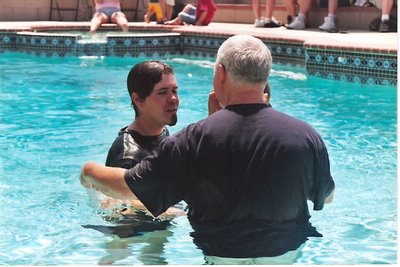
This actually brings me back to the song I mentioned in my last post, GOD OF WONDERS. You see, that song will always be a reminder to me of not just God's transcendence, but of his immanence. I had heard the song before, but I was not particularily moved by it until the day of my brother Mark's baptism. I will never forget standing poolside just before my brother and his wife, Rachael, were going to be baptized so that they could declare publicly their experience with Jesus, and, based upon that experience, their decision to trust him. The church had a guitarist doing acoustic songs. During GOD OF WONDERS I looked over at my brother and his wife, their arms around each other and full of joy. It was a surreal moment, one in which the Holy Spirit moved through me like a gentle wind. Here was a guy I had spent a decade praying for, like me, by all accounts, Mark was a lost cause, but the fully human, fully alive, fully here Jesus Christ specializes in lost causes. (Incidently, this "lost cause" statement is true of Saul of Tarsus, Brennan Manning, and countless others.) It was the nearness, the immanence of God through the experience of Jesus that brought my brother Mark to that moment of trust. As that guitarist sang, "God of wonders beyond our galaxy, you are holy, holy, the universe declares your magesty . . . ." I thought not about a distant God, but a very near God, one that had touched the heart of my brother and I. You see, the only thing more wonderous to me than the Antennae and Milky Way Galaxies or the Andromedae plantary system is the miracle of a hardened heart that has been softened through the experience of the risen Christ. That day in a stranger's backyard, like the David Crowder song that opened this post said, I was thinking, "God of the heavens in this very space."

I think I may now be done processing RUTHLESS TRUST. That is, posting about it. I just want to leave you with these few quotes from the book that mean a great deal to me:

"Much as we would like to, we cannot confine the humble compassionate Carpenter within our mental limitations, thereby robbing him of his Otherness."

"Yet the mysterious love of God is fierce enough to penetrate even those who think that they cannot receive it."

"Trust means the willingness to become absolutely empty of all terrifying and comforting images of God that we have held, so that the gift of God in Jesus Christ may come to us on God's terms."

What great terms they are! I am so thankful to my friend who lent me RUTHLESS TRUST along with a 5-CD set of a weekend of speeches that Manning gave. Through those tools, Brennan Manning has stoked the fires of my passion for Christ. It is a phenomenal thing, trusting this God of Wonders who is both very vast and mysterious as well as very compassionate and near.

Yet, as Manning penned in his book, we need to remember that every word spoken and written about God is by analogy. "For example, we liken divine love to human love. The similarity induces us to think that we are getting a grip on God's love. And yet, though human love is the best image we have, it is utterly inadequate to express the love of the Infinite." I dare say that this divine love affair is the greatest thing I have ever been invloved with.

I am so happy that God is not just the God of outter-space, but he is hear with me in this very space.

Labels: , , , ,

Saturday, October 28, 2006

God of Wonders


I am facinated by these recent photos taken by the scientists at NASA with both the Spitzer Space Telescope and the Hubble Space Telescope. It truly is beyond my comprehension. The first is a just released photo of the Antennae galaxies. The second is a dust ring inside the Andromeda galaxy. The third shows the remains of an exploded star named Cassiopeia A. The colors are the remains of the star's materials. These were all released this past week and can be found all over the Internet. Mind blowing.


The release of these photos is perfectly timed for me as they compliment a book I finished reading. The photos, the news, and the book all make me think of these all-too relevant lyrics from "God of Wonders" by Marc Byrd & Steve Hindalong:

GOD OF WONDERS

Lord of all creation
Of water, earth, and sky
The heavens are your tabernacle
Glory to the Lord on high

God of wonders beyond our galaxy
You are holy, holy
The universe declares your majesty
You are holy, holy
Lord of heaven and earth

Early in the morning
I will celebrate the light
And when I stumble in the darkness
I will call your name by night

Hallelujah to the Lord of heaven and earth


The book I just finished reading is RUTHLESS TRUST by Brennan Manning. In it he writes about the kabod (Hebrew word for "glory") of God. This word kabod speaks to God's transcendence. In writing about the "awesome majesty" of God, he also uses the terms, magnalia Dei. The dictionary says transcendence is to go beyond, exceed, surpass, exist above and in independent of. We in church don't talk enough about God's transcendence.

Manning writes about the Upsilon Andromedae which is the first multiplant system found around a star other than our sun. It is located 264 trillion miles from earth. He writes, "between twelve and fifteen billion years ago, the universe began in a stellar nursery 79.8 quintillion miles away, with an explosion of immeasurable force." Manning discusses the various scientific theories of how it happened and concludes: "Indeed, the moment was so immense that it has shocked our notions of physics. Either the observations are wrong, or there is something out there that we have not begun to comprehend." In a USA TODAY editorial, one of the Andromedae researchers is quoted as writing, "I'm a very troubled theorist."

Manning points out that "When the glory of the transcendent God is not addressed, our focus shifts to human behavior, the cultivation of virtues and the extirpation of vices, the qualities of discipleship, and so on."

For me, here is one of the most powerful passages of his book:

Moralizing surges to the fore in this unbalanced spirituality. At the very outset, it presents a warped idea of the relationship between God and humans. From her parents a child learns of a deity who strongly disapproves of disobedience, hitting one's brothers and sisters, and telling lies. When the little one goes to school, she realizes that God shares the fussy concerns of her teachers. At church, she learns that God has another set of priorities: she is told that he is displeased that the congregation is not growing numerically, that irregular attendance is the norm, and that his recurring fiscal demands are not being met.

When she reaches high school, she discovers that God's interests have expanded to an obsession with sex, drinking, and drugs. After twelve years of Christian indoctrination at home, school, and church, the teenager realizes with resentment that God has been used as a sanction by all those who have been responsible for her discipline--as when Mommy and Daddy, at their wits' end over her mischievous antics as a toddler, allude to "the eternal spanking." Through this indoctrination, God is unwittingly associated with fear in most young hearts.

Moralism and its stepchild, legalism, pervert the characer of the Christian life . . . . Clearly, the God of our imagination is not worthy of trust, adoration, praise, reverence, or gratitude. And yet, if we are unwilling to address the issue of transcendence, that is the only deity we know . . . . The loss of transcendence has left in its wake the flotsam of distrustful, cynical Christians, angry at a capricious God, and the jetsam of smug bibliolatrists who claim to know precisely what God is thinking and exactly what he plans to do.

Wow! Okay, that's the end of the Manning quote and I love it. I put in the italics on the word "our" because God is beyond anything we puny humans can think up. That is why I love the song GOD OF WONDERS and that is why I love these photos of outter space. My God, the Abba of Jesus, is not erratic, changeable, or fickle! He certainly is not out to get me.

Labels: , , ,

Monday, October 23, 2006

Have you sized me up?

In his book, RUTHLESS TRUST, Brennan Manning quotes Philip Roth from his book, AMERICAN PASTORAL (1998). Here's the Roth quote:

"You fight your superficiality, your shallowness, so as to try to come at people without unreal expectations, without an overload of bias or hope or arrogance, as untanklike as you can be . . . . You come at them unmenacingly on your own ten toes instead of tearing up the turf with your caterpillar treads, take them on with an open mind, as equals . . . . and yet you never fail to get them wrong. You might as well have the brain of a tank. You get them wrong before you meet them, while you're anticipating meeting them; you get them wrong while you're with them; and then you go home and tell somebody else about the meeting and you get them all wrong again. Since the same generally goes for them with you, the whole thing is really a dazzling illusion empty of all perception, an astonishing farce of misperception . . . . so ill-equipped are we all to envision another's interior workings and invisible aims."

That is from Manning's chapter 5, the fantastic, "Artists, Mystics, and Clowns," in which the author goes on to write, "Wrong thinking about God and people often begins with a debased image of ourselves" (italics mine). And, did you read the quote from Roth again? You never fail to get them wrong.

We cannot know the heart of another. That is God's job. Yet, how often have I judged people or held past encounters against them? Not only have I done it, but others have done it to me. I've felt it; some have even confessed to me that they did it. Some have judged my motives and hammered me before they even asked if their assessment of my motives were correct. I've done the same. It hurts both ways.

Although not mentioned in Manning's chapter, today this reading brings to my mind these verses:

"Do not judge, or you too will be judged. For in the same way you judge others, you will be judged, and with the measure you use, it will be measured to you."
--Jesus (Matthew 7:1-2)

"Why do you look at the speck of sawdust in your brother's eye and pay no attention to the plank in your own eye? How can you say to your brother, 'Brother, let me take the speck out of your eye,' when you yourself fail to see the plank in your own eye? You hypocrite, first take the plank out of your eye, and then you will see clearly to remove the speck from your brother's eye."--Jesus (Luke 6:41-42)

Perhaps the worst occurance of this type of "plank-eye" behavior is when a Christian is "offended" by somebody's behavior, a behavior which they clearly seem to think they have a full handle on (i.e. judged another's heart). The reaction is so quick, "Oh, my can you believe so-and-so did something so brash, so un-Christlike?" Then, instead of confronting their "friend" about it, they choose to go and tell another Christian rather than talking to the offender. There is, of course, a word for this: gossip. Since gossip is a sin, and, in this scenario, the Christian is gossiping about the first person's perceived sin, this is a clear example of plank-eye. It is a clear example of sizing-up somebody.

I love what else Brennan Manning writes about how we judge others. Also, from chapter 5, he writes:

"In like fashion, our take on others becomes a simple act of reductionsim. Bill Gates is a computer geek, Boy George a flamboyant gay, Rupert Murdoch a power-mad billionaire, Mother Teresa a saint, Bill Clinton a sinner, my boss a dork, my pastor a dweeb, the street person a bum, the waitress a function, Tiger Woods a phenomenon, Wolfgang Amadeus Mozart a brainy zany, Tony Campolo a radical preacher. Our perceptions are woe-fully inadequate."

Man, I love that, woe-fully inadequate! It's safe to talk about the celebrities as in the paragraph above, but how often have we done it to those we claim to know? We could all admit to being able to fill in similiar blanks as these: Shenandoah is a _________; Chrisy is a _________; the Lynds are _________; my first wife was a _________, but my second wife is a _________; the pastor of my old church was a _________, but the pastor of my new church is a _________.

Although not from the same section of the book, Manning addresses related subject matter in chapter 7, "Trusting Jesus." Actually, this is a direct quote from his book ABBA'S CHILD. Surely, if we were to size-up Brennan Manning we would say, "Brennan Manning is a holy man" or perhaps, "Brennan Manning is a modern-day prophet," but even that lavish praise would be reductionism! Notice how he is not too affraid of your perceptions to write the following in the first-person:

"Is there anyone I can level with? Anyone I dare tell that I am benevolent and malevolent, chaste and randy, compassionate and vindictive, selfless and selfish, that beneath my brave words lives a frightended child, that I dabble in religion and pornography, that I have blackened a friend's character, betrayed a trust, violated a confidence, that I am tolerant and thoughtful, a bigot and a blowhard, that I hate hard rock?"

I adore this ability of Manning's to show that we are all enigmas.

Before I depress you or lest you think I am on a soapbox, I want you to know that the message of Manning's profound book (notice by this writing that I am going though chapters a day, a rare occurance for me) is that we all hope and yearn to meet somebody to truly understand and accept us and that Jesus of Nazareth is the fulfillment of that dream! As I type this I have never believed this more.

Manning states that Paul Tillich's definition of trust remains the most meaningful to him. Since this is stated in a book titled RUTHLESS TRUST, this is an important endorsement from the author. Here is Tillich's definition:

Trust is the courage to accept acceptance

Today I am truly having the courage to accept acceptance from my Abba, the same Abba of Jesus. And, here is how this all ties together. I believe that when we are truly feeling accepted by the only one who matters, Christ, we are now free to accept others, to withhold our ill-conceived perceptions of others, and to stop sizing them up. That is my conviction today: I want no part in judgement, I want no part in plank-eye. This is my prayer: "Father, I so want to dish-out the acceptance I have scooped-up through the person that is your son Christ Jesus. Help me to accept that way."

Funny thing is, I should have learned this decades ago, back in the 80s before I was even a Christian. Do you remember the film THE BREAKFAST CLUB? At the end of the film the voiceover reads a letter that the students had written as follows:

Dear Mr. Vernon,

We accept the fact that we had to sacrifice a whole Saturday in detention for whatever it was we did wrong. But we think you're crazy to make us write an essay telling you who we think we are. You see us as you want to see us. In the simplest terms, the most convenient definitions. What we found out is that each one of us is a brain, and an athlete, and a basketcase, a princess, and a criminal.

Does that answer your question?

Sincerely yours,

The Breafast Club

The italics are mine because I think the lesson of this movie is so valuable: Acceptance! I hadn't even thought about why I loved this movie so much until I started reading RUTHLESS TRUST. The fact is, when we begin to ruthlessly trust Christ, we can begin to accept others. That's what THE BREAKFAST CLUB is about. And, that's what the message of Jesus of Nazareth is about. And, that's what RUTHLESS RUST is about too. Indeed, I suspect Manning himself might have ended the Breakfast Club's letter this way:

What we found out is that each one of us is a ragamuffin.
Likewise, I suspect Jesus himself would have ended the letter this way:
What we found out is that each one of us is my Abba's child.
But, maybe I'm just rambling again. Maybe all you are thinking at this point is: "Yea, right, biblical lessons from a secular film! That Doah, he's so unspiritual, that Doah, he's so worldly."
If you are, it's okay because my Abba is very please with me!

Labels: , , , , ,

Tuesday, September 19, 2006

Who Are You?

I am in the process of rereading one of my favorite books, Neil T. Anderson's "Victory Over the Darkness: Realizing the Power of your Identity in Christ." It is the perhaps the most pivotal book I have read since becoming a Christian in 1991. I've read it a bunch of times and I always learn from it.

Today I just wanted to share what I feel is perhaps the most fundamental paragraph of the book; at least it is something that strikes me as the single-most paramount issue in actually living in a Christ-like manner. You might want to read the paragraph below a couple times and really understand what Neil Anderson is saying. I will leave you with his words and spare you from any commentary following the Anderson quote. Suffice it to say that I think this is absolutely HUGE. If you ever want to dialogue more on the topic of our identity in Christ, I'd love to do so.

Here it is:

Understanding your identity in Christ is essential for living the Christian life. People cannot consistently behave in ways that are inconsistent with the way they perceive themselves. You don't change yourself by your perception. You change your perception of yourself by believing the truth. If you perceive yourself wrongly, you will live wrongly because what you are believing is not true. If you think you are a no-good bum, you will probably live like a no-good bum. If, however, you see yourself as a child of God who is spiritually alive in Christ, you will begin to live accordingly. Next to a knowledge of God, a knowledge of who you are is by far the most important truth you can possess.

Labels: , ,

Friday, June 30, 2006

I'm Not The Vine

It never ceases to amaze me how certain topics or issues will tend to come up repeatedly in little short spurts over a short period of time. You know, you hear the same piece of scripture at church, then on the radio, then your friend mails you a postcard with the verse on it, or something strange like that. When that happens there seems to be at least three possible approaches: (1) write it off as coincidence; (2) consider the fact that God is trying to tell you something; or, (3) maybe you're so unaware of it you don't even give it a thought. There have been times when I've taken all of these approaches. Lately, however, I've been trying to take a serious look at the reoccuring message and humbly ask God, "What are you trying to tell me here?" Over the last two weeks or so He's been saying, "Abide in me Doah."

In John 15:5 Jesus says, "I am the vine, you are the branches. He who abides in Me, and I in him, bears much fruit; for without Me you can do nothing." (New King James)

Two Sundays ago in our youth group we decided to really dig into this horticultural analogy given by Christ. In fact, we asked the junior highers to memorize it from a different translation as follows: "I am the vine; you are the branches. If a man remains in me and I in him, he will bear much fruit; apart from me you can do nothing." (NIV)

Notice that "abide" is translated "remain" in that version. I looked it up in the dictionary and the other meanings that might work here are endure, dwell, or reside.

I carried that verse around for a week and tried to really know it and, more importantly, live it. I wanted to get it. I have to be honest, I don't think I do a very good job of totally remaining in Christ on a minute by minute basis. And, as Tyler Durden asks in FIGHT CLUB, "How's that working for ya?" The answer for me is, "Not good."

Anyway, the following Sunday (last Sunday), I'm sitting in the "big church" and our associate pastor was going to give the message which is rare. Then, he tells us we're going "old school" and he wants us to, out of respect for God's word, stand up and recite, in unison, today's scripture. Trust me, that is even rarer. So, before he says what passage it is, I crack my Bible open--and because I had this bumper sticker in there that was a gift from two junior high girls--my Bible opens to John 15:5 and he says, "We're going to read John 15:5 together."

In the translation printed in our program that day one line was different: "No branch can bear fruit by itself; it must remain in the vine. Neither can you bear fruit unless you remain in me." I like that because it's clear to me. I'm looking out at this lemon tree as I type this and I get that. If I was to cut off one of the branches from the tree and lay it on the ground, it would stop producing fruit. Many times, I am like that, I'm off on my own, trying to produce fruit.

This actually reminds me very much of step one of the 12 steps in Alcoholics Anonymous which, in part says, "We admitted we were powerless." That's a very difficult concept to surrender to. I for one, love to feel powerful and I really love feeling totally in control even more. Looking at that step right now, I see it as saying, "Admit that you are a branch that has been severed from the tree by choice." If you are familiar with A.A. then you know that the next two steps are designed to have you grafted back onto the vine. In effect they say, "Remain in me. Then, I will remain in you, and you will bear much fruit." Supposedly, I did step one back on June 27, 1991; however, I often forget that the 12th step brings me back to the first and I'm supposed to do that on a daily basis, even moment-by-moment basis if necessary. I get so full of myself that I start thinking that I'm the vine. Fortunately for me, this week God put somebody in my life that forced me to begin looking at these steps more closely. Yet another nudge from God.

As I reread the book of John, chapter 15, verses 1-17, I see the word "abide" at least nine times in there. Christ keeps saying, "Abide in me Doah." Why do I keep refusing when, every time that I have submitted to Him has gone so well? This brought me back to something else I am rereading now.

One of my all-time favorite pieces of writing is chapter 3 from my friend Don Toshach's book, A Thirst For More. That chapter is titled "Facedown in the Garden" and it is an open letter to Jesus. A letter from somebody who finally really got chapters 14 to 17 of John. I will close this post with an excerpt from that chapter. The last sentence is my prayer today. Every thing that follows here is Don's, not mine:

Lord, when I look at my life, I have a hard time remaining or dwelling with You. I find that I tend to exist next to You, tacking You onto my agenda. I'm busy, I've got stuff to do, there are many priorities. How can I live in You?

I'm able to abide. You remind me that I abide with my wife. I abide with the newspaper and television. I have abided with the Olympics and major sporting events. I have abided in books for the sake of earning degrees. I have abided with doing ministry. The justifications fly: "This is important; this is worth of time."

Jesus, I hear You say, "Okay, so I'm not worthy of your time?" Ur, oh, well, uh . . . it seems that way, doesn't it? You say it over and over here. "Remain in Me." You can do nothing apart from Me. How does that work? You could say, be transfixed by Me. Be gripped by Me. Live with Me. Hunger for Me. Talk to Me. Enjoy Me. Don't confine Me to a spot on your schedule . . . Let Me be your schedule.

Jesus, the first part of remaining is up to me, but if I remain in You, You will remain in me. Help me to remain, not just give you the remains, the leftovers. Show me what I need to leave behind or rid myself of in order to remain in You.

Labels: , , , ,

Thursday, April 06, 2006

A New Kind of Christian

I'm reading this book, "A New Kind of Christian," by Brian D. McLaren and I really dig it. It's making me think a lot. It's a bunch of conversations between a pastor, Dan, and his daughter's science teacher--turned Dan's friend--Neo. Here's a a great paragraph:

"Most modern people love to relativize the viewpoints of the others against the unquestioned superiority of their own modern viewpoint. But in a way, you cross the threshold into postmodernity the moment you turn your critical scrutiney from others to yourself, when you relativize your own modern viewpoint. When you do this, everything changes. It is like a conversion. You can't go back. You begin to see that what seemed like pure, objective certainty really depends heavily on a subjective preference for your personal viewpoint."

That quote is so important to me. It's from a lecture Neo is giving to college students in the book.

Labels: ,